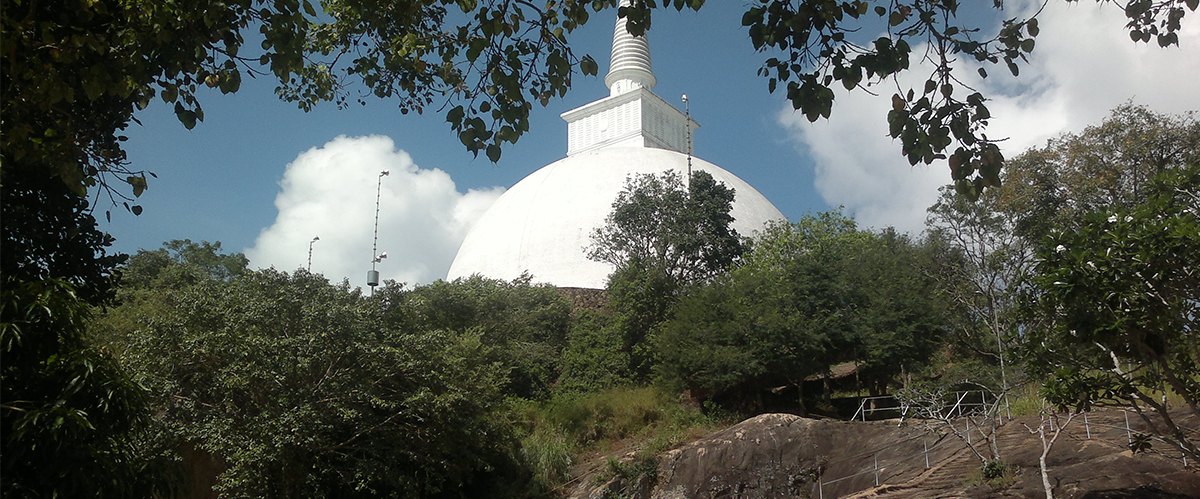
Passing along the coastal road travelling South from Colombo, the first large town is Kalutara. Approaching the town the striking Gangatilaka Vihara, one of the few Buddhist monuments that permit entry and a true highlight worth visiting stands at the edge of the Kalu Ganga, (Kalu River), passers by are encouraged to stop and make a donation in one of the yellow offerings boxes that line the busy highway.
Once an important market town famous for spice-traders Kalutara, is now the centre of the thriving local basket ware industry. A bustling market town and the junction for travellers journeying inland to such cities as Ratnapura and the Sinharaja Rain Forest, along the side of the road stalls of brushes, brooms and baskets hang out in the sun vying for passing trade.
At this point on its journey South the road winds inland away from the coast, it is therefore necessary to turn towards the sea down small narrow roads passing private bungalows that occupy seemingly prime positions close to the railway track, a vital link between the capital and the coastal conurbations.
Kalutara has still to recognise the potential for tourism in the area and it is only a few enterprising individuals that have opened souvenir and tourist shops close to the hotels. Restaurants are still confined to the hotels in the immediate area since eating out as a pleasurable pastime has yet to develop. Fortunately, with Colombo only 43km distant and taxis freely available and economical it is possible for the determined to spend an evening in the capital City, where there are some very fine restaurants and clubs for those who seek lively entertainment.
KALUTARA once an important spice-trading center, the city's name is derived from the Kalu Ganga River ('Black River' in native Sinhala). In the 11th Century, the town was temporarily made a capital on the orders of a South Indian Prince. The region was later planted with coconut trees, whose by-products are used for both internal and external trade. The location also boast fortifications dating back from the times when Portuguese, Dutch and British vied for control of the area.
The 38-meter long Kalutara Bridge was built at the mouth of the Kalu Ganga River and serves as a major link between the country's western and southern border. At the southern end of the bridge lies the 3 stories-high Kalutara Vihara, a Buddhist temple built in the 1960s which holds the distinction of being the only stupa in the world that is hollow.